



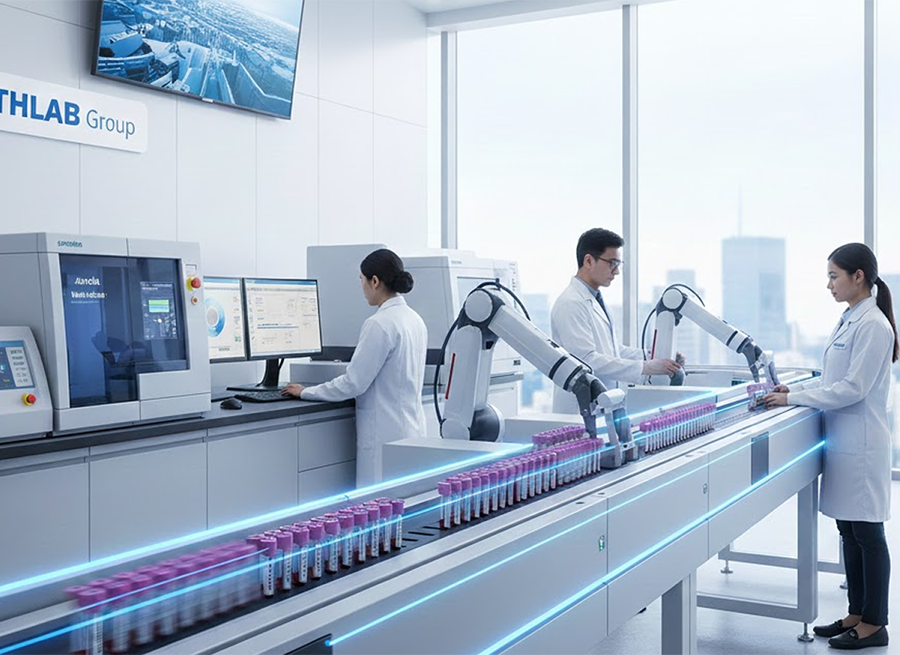
In the world of modern medicine, time is often the most valuable resource. When a patient is waiting for a critical diagnosis or a researcher is on the verge of a breakthrough, every minute counts. Enter Lab Automation—the technological revolution that is transforming clinical and research laboratories from manual workstations into high-speed, precision engines.
Gone are the days when lab technicians spent hours manually pipetting liquids or labeling test tubes. Today, automation is redefining what’s possible in healthcare and science.
1. Removing the “Human Bottleneck”
Manual processes are prone to two things: speed limits and human error. Even the most skilled technician can experience fatigue, leading to minor inconsistencies that affect results.
- Consistency at Scale: Automated systems perform the same movement with the exact same precision 1,000 times in a row. This level of standardization is nearly impossible to achieve manually.
- 24/7 Operations: Unlike human staff, automated platforms can run overnight and through weekends, ensuring that samples collected in the evening are processed and ready for review by the time doctors start their morning rounds.
2. Radical Reduction in Turnaround Time (TAT)
The most visible impact of lab automation is the speed at which a sample goes from “drop-off” to “result.”
- Rapid Sorting: High-track automation systems can sort thousands of tubes per hour, directing them to the correct analyzer without a human ever touching the vial.
- Instant Data Integration: Automated labs are usually synced directly with Electronic Health Records (EHR). The moment the machine finishes the analysis, the data is pushed to the physician’s tablet, shaving hours—or even days—off the waiting period.
3. Enhancing Safety and Precision
Automation doesn’t just make labs faster; it makes them safer for both the staff and the patients.
- Reduced Exposure: Automation minimizes the need for lab personnel to handle hazardous chemicals or infectious biological samples.
- Micro-Volume Accuracy: Modern robots can handle liquid volumes as small as a single microliter ($\mu L$). This means fewer samples are needed from patients (especially important in pediatrics) while still maintaining high diagnostic integrity.
“Automation is not about replacing the scientist; it’s about freeing the scientist from repetitive tasks so they can focus on data interpretation and complex problem-solving.”
4. The Future: AI and Integrated Tracks
The next step in lab evolution is the marriage of Robotics and Artificial Intelligence.
- Predictive Maintenance: AI can sense when a part is about to fail or when a reagent is running low, preventing unexpected downtime.
- Auto-Verification: Smart systems can flag “abnormal” results that require a human eye while automatically approving “normal” results, allowing the lab to process the bulk of its workload at lightning speed.
Summary: Why It Matters to You
For the average person, lab automation means that a “scary” health concern can be addressed in hours rather than weeks. It means that new life-saving drugs can be brought to market faster because the testing phase was accelerated by precision robotics.
Lab automation is the silent engine behind modern miracle medicine, proving that when we automate the process, we accelerate the cure.